Articles

Published posts from Hilal Forum.

  • Published: 8 April 2026

    Fatwa giving permissibility of usage astronomical data to announce Hilal

    I begin with the name of Allah, the Kind the Caring. 

    Question

    What do the scholars of Islam say about the question of the moonsighting in Britain? It has been a topic of heated discussion amongst British Muslims since the 1970s. A group of Sunni scholars and Masajid are following the Astronomical calculations method for the beginning of Ramadhan and celebrating Eid. What is the evidence from Shariah for the validity of accepting astronomical calculations?

    Kashef Saleem Nottingham

    Answer

    This fatwa is atypical, as it presents the fatawa of several prominent contemporary Muftis. The fatwa is still based on the Quran and Sunnah, Arabic etymology, classical canonical legal texts, and opinions of scholars regarding the validity of astronomical calculations for determination of moon sighting. 

    The mufti of Singapore Shaikh Syed Isa bin Semait issued the first fatwa on this subject in 1974.i He said “the fatwa committee of Singapore concluded that the beginning of Ramadan could be determined through astronomical calculations. This conclusion rested upon the verses in Surah Yunus 5 and Surah Al Rahman 5. Which asserted that the orbits of the moon, sun and other celestial bodies adhered to the calculations of Allah.ii Astronomers, particularly contemporary ones comprehend these calculations and the advanced scientific instruments have validated the accuracy of astronomical calculations. Therefore, the fatwa committee acknowledged that past scholars had reservations about astronomy due to the unavailability of sophisticated tools during their time and were unsure about the precision of the calculations.”1 the reason the fatwa committee of Singapore took this action was in their own words “the mufti noticed how the uncertainty of the dates in our Islamic calendar lead to serious difficulties in the lives of Muslims in Singapore.”

    The Former Grand Mufti of Egypt, Shaikh Ali Jumma gave a fatwa in 2011 in regards to this question he said “After a careful reading of the issues raised in the aforementioned question, and consulting specialists in astronomy at the National Institute for Astronomical and Geophysical Research, we report the following: The first issue related to the consideration of astronomical calculation is: we consider them one of the means of proving the appearance of the crescent. This is indicated by the Quran and authentic Ahadith. The Sunnah allows for considering the astronomical calculation, so most scholars consider it proper, particularly when the visual sighting is not possible. The astronomical calculation is definitive, whilst the visual sighting can be wrong sometimes. The principle is the definitive takes precedence over the speculative.”

    Shaikh-ul-Islam Professor Tahir-ul-Qadri gave a similar fatwa, he said: “My position is that the sighting should not be limited to seeing with the eye or the telescope. If knowledge comes from modern science, then this is equivalent to sighting and does not oppose the Hadith. Furthermore, we are not doing Ijtihad but taking the meaning of the Prophet’s words. He argues that ruyat or sighting mentioned in the Hadith doesn’t just mean seeing with eye but refers to gaining knowledge. He quotes Raghib Isfahani the famous Lexicographer of the Quran, who argues that ruyat has four meanings:


    1. Ruyat is seeing with the eye or gaining knowledge through any of the five senses

    2. Ruyat means "judgement based on intelligence", that is driven by mental process and can be unrelated to the senses. That’s why calculations, theology, scientific analysis, etc. are sources of valid knowledge. Through them we understand, know, and establish concepts. Just as seeing with the eyes is the true meaning of ruyat, in the same way, seeing through the knowledge of intellect and mind is 100% meaning of ruyat. This is neither ijtihad nor a new meaning of ruyat

    3. Ruyat means thinking, like scientific research.

    4. Ruyat refers to rawyat with the help of intellect, to know with the help of reason, whatever knowledge we talk about today, knowledge of divine knowledge, it is ruyat
      In conclusion gaining of firm knowledge is called ruyat. Jawahir al-Qamoos and Lisan al Arab are also in agreement with this the meaning of ruyat

    Prof Tahir-ul-Qadri boldly said “there can be no unity on moonsighting until we all agree to accept the validity of astronomical calculation.”2

    Mufti Saif ur-Rahman (d. 2021) was asked by Pir Syed Maruf Hussain shah of Bradford in April 1993 to explain how we can begin the month in UK where the sky is cloudy most of the time. He wrote a detailed fatwa on the subject. You can read the full Urdu fatwa on… The erudite Mufti sahib said “The third method is astronomical calculations for beginning Ramadhan and celebrating Eid. If the first two methods are not possible (sighting the moon due to cloud or completing 30 days of the month) follow the third option: when expert astronomers say that the crescent would be visible if it was not cloudy. This method is rational and close to the Shariah.” He concluded “in these three cases, the first is a direct method of seeing, whilst the latter two are indirect methods of sighting. We mustn't deviate from these, like those who use birth of the moon. The third method is regarded by some scholars as an interpretation of the Prophetic command “Faqdiru lahu” ie. Calculate if you can’t see it.” This fatwa was signed by dozens of Sunni Barelvi Scholars, including members of the current Sunni Ruyat Board. 

    -Issued by British Fatwa Council, Nottingham

    Pirzada Imdad Hussain, the commentator of the Quran and Bukhari is an erudite and respectable Sunni scholar in Britain, in his commentary on Bukhari he presented a long treatise on the hadith about the sighting of the moon (Imdad-ul Bukhari vol 3:526-50). He believes that “if we can accept the moon that is seen with the aid of telescope then a similar case can be made for accepting the prediction of the observatory. People have landed on the moon; therefore, they precisely know its location so denying their calculation is not an easy matter.” Pirzada sahib Said, “nowadays the observatories are so advanced that they can forecast many years ahead where the moon would be. These findings of the observatory are presently available on the Internet. Therefore, there is no issue in relying on the observatory since our difficulty has been solved. This was the moon of the first date of the moon which we couldn't see because of the clouds but the observatory has made it possible… on page 531 he concludes “in brief, if the scholars in the light of Shariah can find the permissibility of making announcement for Ramadan and Eid, this will make things easy for the British situation. And even if the Saudis reject the scientific observations but the Crescent is present on the Saudi horizon on the 1st day of the month then in Britain people can celebrate according to the Saudi announcement.”

    Mufti Dr Shawky Ibrahim Allam, the current grand Mufti of Egypt wrote a fatwa in in 2015 regard the seeing of the crescent moon. He said: “It is obligatory for all the people of a country to follow their imam in seeing the crescent or not. The sighting may differ from one country to another, provided that the sighting is possible according to the astronomical calculation”.

    Muhammad Shaukat Odeh3 wrote a research paper regarding the crescent of Ramadan and the difference between astronomical calculation and sighting the moon with the eye: Some jurists permitted the adoption of astronomical calculation in negation only. This is in the sense that if someone testifies to seeing the crescent, and astronomical calculations indicate that seeing the crescent is not possible, then the testification of seeing the crescent will not be accepted. Among the most famous of those who held this opinion was Taqi Ad-Din As-Subki, who was one of the great Shafi’i jurists in the first half of the eighth century AH. As-Subki mentioned in his fatawa if the calculation denies the possibility of seeing the cresecent, it is obligatory for the judge to reject the testimony of the witnesses, he said: “Because the calculation is definitive, whilst the testimony and the news are speculative. The speculative can not oppose the definitive, let alone precede it.”
    Some jurists permitted the adoption of astronomical calculation in negation and affirmation; Supporters of this opinion have increased from those of the previous opinion that if astronomical calculations indicate the presence of the moon after sunset in a position that allows it to be seen as a crescent; It is taken by astronomical calculations, and the next day is the first day of the Hijri month without requiring it to be seen with the naked eye. The most famous is Mutrif bin Abdullah, a senior Shafi’ scholar of the third century AH, and Ibn Qutayba al-Dinuri. Among the contemporary is Sheikh Ahmed Shakir, Sheikh Mustafa Al-Zarqa, and Dr Yusuf Al-Qaradawi (Al-Qudah 1999)

    Conclusion

    These fatawa from eminent scholars provide evidence that astronomical data is superior to the naked eye due to certainty of the moon being present. This is true for countries in the northern hemisphere like the UK, where the possibility of seeing the crescent is rare. As stated by Imam As-Subki the moonsighting with the naked eye is speculative but the astronomical data is definitive. We therefore recommend that in the UK we adopt astronomical data as the primary method of moonsighting for determining the Islamic month. 

    And Allah knows best.

    This Fatwa is written by British Fatwa Council and endorsed by 

    Allama Ghualam Rabbani Afghani, Chairman Faizan E Islam London

    Allama Mufti Misbahal Malik, Chairman …

    Allama Rasool Bakhsh Saeedi, Birmingham 

    Mufti Faiz Rasool, Bristol

    Mufti Hassan Raza, Bradford

    Allama Hassan Rabbani Imam Zia Ul Quran Glasgow,

    Allama…


    3 Muhammad Shaukat Odeh is an astronomer and researcher, a member of the International Astronomical Union. He is interested in the topics of calculating prayer times, seeing the crescent, monitoring meteors, … He is the director of the International Astronomy Centre and a founding member of the Arab Union for Astronomy and Space Sciences. Wikipedia)


    i the office of mufti of Singapore, MUIS recently published the fatwa with very useful notes and explanation of the basis of using astronomical calculations. The booklet is cold “Singapore approached me calendar.”

    ii Surat Yunus: 5 “He created the sun with its radiant glow and the moon its reflected light, and precisely determined its phases, so that you might calculate the passing years and keep time. Allah did not create all that except for a clear purpose, to explain the signs of creation for people who have knowledge.” And Surat Al Rahman: 5, “The sun and the moon have exactly measured orbits.” (The majestic Quran) and according to MAS Halim “the sun and the moon follow their calculated courses.” And according to The clear Quran by Khattab “the sun and the moon travel with precision.”

    Read more
  • Published: 8 April 2026

    Benefits of using astronomical calculations for moonsighting: Harnessing Science in the service of Shariah

    Recently Karimia institute’s Imams and the trustees decided to follow the UK and Europe Hilal forum. Here I want to explain our thinking behind this decision. I know it is not easy to make an abrupt change, for decades we have followed the sighting of the moon with the eye. Therefore, I request you to decide prayerfully and carefully. Since this will influence not only your family but other communities. My appeal is let’s not to be squeamish about astronomical calculations, nor dismiss it lightly. I'm not at all angry nor dismissive of those who don't follow this method, but I do believe it is a better method, since it offers us opportunity to begin Ramadhan Kareem without tension, and controversy and to celebrate Eid with joy. Please read why we took this decision.

    Since the late 1980s every year I witnessed conflicts, aggressive debates, and even quarrelsome behaviours amongst Muslims in the mosques and in families around moonsighting. A terrible condition, wholly unislamic and unacceptable. It is time now to consider putting an end to this. I have been hoping that something will happen that will bring us together. Particularly the others would change but not myself. Alhamdo-lillah, the advancements in astronomy and computing are compelling scholars to adopt Scientific calculations as an accurate way of beginning the Lunar month. Several Muslim countries, Turkey, Jordan, Egypt, Singapore and the gulf states do so. There is no doubt about the legitimacy and the accuracy of astronomical calculations as being source of knowledge for deciding the beginning of sacred months. Many scholars have given fatwa on that. See British Fatwa council’s fatwa.

    Karimia institute’s Imam's and the trustees decided to follow the UK European Hilal forum. Islamic Sharia is logical, and is based on reason, it's rational and natural way of life and appeals to human reason. The Islamic Lunar month begins with the sighting of the moon. This is straightforward however on the island of Great Britain it isn't possible since it’s in northern hemisphere and the probability of sighting the crescent anytime in the year is about 5%. Furthermore, the sky is often cloudy thus impairing moon’s visibility. Therefore, we must rely on reports from abroad. This is where the problem begins, who do we follow?

    Most of the developed Muslim countries have excellent observatories and provide enough data for the scholars to make the decision, without requiring them to see the moon. Muslim countries observatories base their decisions on the Quran, Allah says, “The sun and the moon move in set orbits.” (Al Rahman:5) and “He gave the sun its radiant glow and the moon its reflected light, He precisely determined its phases, so that you might calculate the passing years and keep time. Allah did not create all that except for a clear purpose, to explain the signs of creation for people who have knowledge” (Yunus: 5) In other words, they follow an accurately calculated course. everyone recognises the accuracy of sunrise and sunset and we accept this categorically to determine our daily five prayer times. For thousands of years Astronomers have accurately measured the orbit of the moon around the sun, it is 29 days 12 hours and 42 minutes. Nowadays with satellites in the sky and high-resolution telescopes they can find the moon anywhere, calculate its location precisely determine the probability of its visibility. The moon has a diameter of 3,500KM it’s a massive rock, that acts as a reflector. Such a massive body is easily seen with the satellites in the space. The accuracy is incredible and precise. Astronomers have now determine the criteria for the visibility of the moon.

    The Hilal Forum’s Formula is:

    1. The conjunction (the moon’s new phase or the birth of new moon) must have occurred in the UK.

    2. The moonset must be after sunset in the UK, the moon must remain on the horizon for at least 20 minutes.

    3. The visibility of the moon in the UK or anywhere else must be in Category A, the moon is visible with naked eye; B, visible only in perfect condition; or C, an optical aid needed, 

    This formula is used by most moon sighting bodies. However, it does not require that the moon must be seen with naked eye. This makes it a fully astronomical and calculations-based formula. The benefits of this formula are: it is Sharia compliant, it allows for accurate forecasting of the beginning of the Islamic month well in advance of the sacred months, it's an inclusive formula that embraces many of the Muslim countries’ observatories. Thus, creating unity. This has the potential of uniting Muslims globally; this makes it attractive and simple formula. 

    Discussion

    I can clearly see the benefits of this approach and that is why we have adopted it at Karimia Institute along with many other mosques and Islamic centres throughout UK. We pray that Allah gives our leaders wisdom and passion to adopt this formula, the masjid Namazi’s must talk with their Imams and committees to take part in this. Those interested in reading full arguments from Fiqh about astronomical data will be able to read this fatwa. 

    For Eid al Adha, Hajj and Qurbani please read my e-book on the subject. This is time to learn, reflect and thank Allah.

    Dr Musharraf Hussain OBE, DL

    Director Karimia Institute, Nottingham 

    Read more
  • Published: 8 April 2026

    Fiqh al-Hilal and the rotation of the Moon

    Fiqh al-Hilal is the derivation from crucial principles of the Quran, sunnah, and opinions of jurists on deciding when to finalise the beginning of a new Islamic month. It is the study of the correct method of determining the crescent for the beginning of the new Islamic month, which is to be certain of the end of the previous month and the start of the new month.

    Interesting facts about the Moon:

    The Moon is not a planet but a satellite of Earth. 

    The surface area of the Moon is 14,658,000 square miles or 9.4 billion acres.

    Only 59% of the Moon's surface is visible from the Earth.

    The Moon rotates at a speed of 10 miles per hour compared to the Earth's rotation of 1000 miles per hour.

    From Earth, we always see the same side of the Moon; the other side is always hidden. 

    The dark spots we see on the Moon that make up the image of a man on the Moon are craters filled with basalt, a very dense material.

    The Moon is the only extraterrestrial body ever visited by humans. 

    The Moon has no global magnetic field.

    The diameter of the Moon is about 1/4 the diameter of the Earth. 

    About 49 moons would fit inside the Earth.
     

    The rotation of the Moon around the Earth:

    The Moon revolves around the Earth from west to east. This revolution of the Moon is known as a lunar month. The Moon completes a full revolution of the Earth every 27 days, 7 hours and 43 minutes.

    Therefore, one would assume that the lunar month period should also be consistent. However, we notice that lunar months, i.e. the time from one crescent to the next crescent, can be either 29 days or 30.

    The reason for this discrepancy is the movement of the Earth around the Sun. If the Earth remained in its position, the lunar month period would be 27 days, 7 hours, and 43 minutes. However, within that timeframe, the Earth would have also moved a considerable distance, with the Moon also participating in this movement with the Earth. So, the Moon has to cover more distance in its orbit to return to the original position between the Sun and the Earth, which can take up to 2 or 3 extra days (The variable days is due to what phase of the Earth's orbit we are in and the phase of the lunar orbits, i.e. perigee or apogee). Thus, it takes 29 days to return to the original shape or sometimes 30.

    imgImage removed.


    imgImage removed.


    A complete rotation of the Moon around the Earth is 27.3 days, known as a Sidereal month. A lunar month (the time from one crescent to another crescent), 29 days, is called a Synodic Month.

    Before understanding Fiqh Al-Hilal, it is essential to understand a few terms.

    New Moon (MUHAAQ):

    When the Moon completes its cycle in 27.3 days, it must travel further to come directly in front of the Sun, which is the birth of the new Moon. This new Moon is called Muhaaq. At this point, the Moon is completely dark.

    Crescent (Hilal):In the تفسير (exegesis) of Surah Al-Baqarah, verse 189, Imam Fakhr al-Din al-Razi states:الْأَهِلَّةُ جَمْعُ هِلَالٍ وَهُوَ أَوَّلُ حَالِ الْقَمَرِ حِينَ يَرَاهُ النَّاسُ، يُقَالُ لَهُ: هِلَالُ لَيْلَتَيْنِ مِنْ أَوَّلِ الشَّهْرِ ثُمَّ يَكُونُ قَمَرًا بَعْدَ ذَلِكَ، وَقَالَ أَبُو الْهَيْثَمِ: يُسَمَّى الْقَمَرُ لَيْلَتَيْنِ مِنْ أَوَّلِ الشَّهْرِ هِلَالًا، وَكَذَلِكَ لَيْلَتَيْنِ مِنْ آخِرِ الشَّهْرِ، ثُمَّ يُسَمَّى مَا بَيْنَ ذَلِكَ قَمَرًا

    “Al-ahillah is the plural of hilāl. It denotes the initial phase of the moon when it becomes visible to the naked eye. The term hilāl is applied to the moon for the first two nights of the lunar month; thereafter, it is referred to as qamar (the moon).
    Abu al-Haytham stated that the moon is called hilāl for two nights at the beginning of the month, and likewise for two nights at the end of the month, while during the intervening period it is termed qamar.”

    From this linguistic and exegetical foundation, it is understood that the designation hilāl is intrinsically linked to visibility—that is, the moment when the moon emerges from conjunction (muḥāq) and becomes illuminated by sunlight, so that its brightness can be observed.

    When the moon exits conjunction and enters the domain of solar illumination, it reflects sunlight and becomes perceptible. Once this illuminated crescent is observable—whether by the naked eye or with optical aid—it is termed hilāl.

    Contemporary astronomers, taking into account the classical juristic definitions of hilāl and supported by repeated empirical observations, have formulated a practical criterion: when, after conjunction (i.e., lunar birth), the moon attains an altitude of approximately 5 degrees above the horizon and an elongation (angular separation from the sun) of about 8 degrees, it reaches a state in which it can be classified as a hilāl.

    Lunar-rising point  (Matla'):

    Linguistically, it refers to a place of rising of an astronomical body. Its plural is known as Mataali'. The point at which the Moon rises is called the Matla' of the crescent.

    Read more
  • Published: 8 April 2026

    The Ruling About the horizon of moon-sighting، Global or Local?

    In Arabic, Matala' means the place from which astronomical bodies rise; Matala' al-Hilal refers to the place on the horizon where the crescent Moon rises. Nowadays, it is generally known that each country has its crescent Moon. The crescent Moon seen in Belgium is for the people of Belgium; the crescent Moon seen in India is for the people of India; the crescent Moon seen in Pakistan is for the people of Pakistan; and the crescent Moon seen in Britain is for the people of Britain. Despite this ruling seeming to be very reasonable, it is, in fact, this ruling of local moonsighting which conflicts with the Islamic philosophy of unity of Ummah and Khilafah.
     

    : ھُوَ الَّذِیۡ جَعَلَ الشَّمۡسَ ضِیَآءً وَّ الۡقَمَرَ نُوۡرًا وَّ قَدَّرَہٗ مَنَازِلَ لِتَعۡلَمُوۡا عَدَدَ السِّنِیۡنَ وَ الۡحِسَابَ ؕ سورۃ یونس :


    He (Allah) gave the sun (its) radiant glow and the moon its light, He determined their phases precisely, so you might (calculate) the passing years and keep time.
    Surah Yunus is a Makkan Surah in which there are arguments for monotheism. Fasting (Sowm) and prayer were not obligatory in Makkah then, but the Arabs used to determine their dates with the Moon for their daily life. Similarly, they used to determine the months of Hajj and sacred months by the Moon. When the fasting of Ramadan became obligatory after the migration to Madinah, fasting in the month of Ramadhan became obligatory, as did the act of Hajj. The holy Quran commanded that the month of Ramadan, the sacred months, and the days of Hajj with the crescent must be determined.
    Islam is not only a religion of worship or rituals but also a religion of a caliphate and state system. The Hijri calendar was created during the caliphate of Hazrat Umar Farooq. Different regions and states were part of the Islamic Caliphate. For example, the Holy Hijaz (Saudi Arabia) and Iran shared the exact date and calendar, even though they differed by thousands of miles. Similarly, this system continued till the end of the Ottoman Caliphate, when the crescent of the Ottoman Caliphate was announced in Egypt; Eid would also be celebrated in Anatolia. In addition, when the crescent was spotted in the United subcontinent of India pre-1947, Ramadan and Eid were celebrated on the same day in united India. In the 20th century, when the unity of Muslims was divided, the Ottoman Caliphate ended, and the united subcontinent of India was also divided.
    Hence, new countries came into being through geopolitical division, and every country began declaring its crescent. For example, Turkey developed its crescent sighting system; Arab countries established their separate system of moonsighting. Similarly, the announcement of the crescent Moon was the same in United India. However, after the partition of India, the announcement of the crescent of India and Pakistan was divided. Then, if the crescent were sighted in Dhaka in East Pakistan, it would be announced in Lahore. When Bangladesh was established in 1971, Pakistan became divided, resulting in the announcement of the crescent also being divided. Now Pakistan has its announcement, and Bangladesh has its announcement of the crescent. In this way, just as this Ummah was divided politically, it was also divided on the crescent issue. This division was considered a desirable practice for the validity of local moonsighting. However, this was not a good practice. Muslims of every region and country should see the Moon. But it is necessary to see the crescent of the month of Shaban, the month of Ramadan, the month of Shawwal, and the month of Dhul-Hijjah. If it is seen, then it should be declared; if it is not seen in one area, but it is seen in another location, then it must be followed.


    There are two groups of Islamic jurists on the issue of different horizons of moonsighting. One group is the Hanafi, Maliki, and Hanbali schools of jurisprudence
    Allama Abd al-Rahman al-Jaziri wrote  in his famous book Fiqh Al -al Madhahab al-Aba,ah.
    "If the crescent Moon is sighted on one location on the earth, fasting becomes obligatory in all areas irrespective of distance, whether far or near. According to three imams (Imam Abu Hanifa, Imam Malik, and Imam Ahmad bin Hanbal, may God bless them and grant them peace), the difference in the moonsighting horizon is invalid.
     

    إذا ثبت رؤية الهلال بقطر من الأقطار وجب الصوم على سائل الأقطار، لا فرق بين القريب من جهة الثبوت والبعيد إذا بلغهم من طريق موجب للصوم. ولا عبرة باختلاف مطلع الهلال مطلقاً، عند ثلاثة من الأئمة؛ وخالف الشافعية، (الفقہ علی المذاھب الاربعۃ)


    The majority of the scholars believe in global moonsighting. Of course, Imam Shafi'i's Fatwa is different. According to Imam Shafi, )may God bless him and grant him peace(، it is about 124 km. Later, scholars of the Shafaee school of Fiqh also adopted the ruling of global moonsighting of three imams (Imam Abu Hanifa, Imam Malik, and Imam Ahmad bin Hanbal, may God bless them and grant them peace)


    Imam Ahmad Raza Khan, (may God bless him and grant him peace), is the only thinker in the subcontinent who emphasized the Islamic jurisprudential perspective of global moonsighting for the unity of the Ummah and Khilafah.

    In his work Fatawi Rizwiyyah, Imam Ahmed Raza Khan Barelvi, (may God have mercy on him) stated that practicing different moon-sighting horizons is not accepted within the Hanafi Fiqh. This view is upheld by Imam Abu Hanifa, Imam Abu Yousaf, and Imam Muhammad. It is considered Dhair al Rewayah, as agreed upon by these scholars, and it is not permissible to deviate from this established framework in Hanafi fiqh.

    Responding to a query from Maulana Riasat Ali Khan on the validity of a witness from another city regarding the sighting of the moon for Eid al-Adha when the distance is considerable, Imam Ahmad Raza Khan, may God bless him and grant him peace, confirmed that such testimony would be valid as per Shariah, even if the distance between the places is significant. (one month duration of distance)
    Author of Encyclopaedia Hanafiya, Sadr al-Sharia Allama Amjad Ali Azmi Rehmatullah Alaihi wrote in his book Bihar Shariat. 
    "If the crescent is sighted in a country, it is valid for that country and the world. But according to them, this ruling of the crescent for another country should be proved by Shari'a evidence on the same date."
    (Bahar Shariah Volume I, Kitab al-Sowm)

    Furthermore, Imam Ahmad Raza Khan rejected the notion advocated by scholars such as Allama Shami and Allama Abdul Hai Lakhnavi, regarding different moonsighting horizons for Eid-ul-Adha and Shawwal-ul-Mukarram.

    Regarding the hadith from Sahih Muslim (Hadith e Kuraib), Imam Ahmad Raza Khan emphasized that when credible evidence of moon sighting is received, the people of the East should fast or celebrate Eid, based on the Shariah guidelines if the people of the West have already sighted the crescent.

    Imam Ahmad Raza Khan demonstrated his commitment to following the Shariah when faced with a situation where conflicting moon sighting dates arose. He made a decisive ruling on the end of Ramadan and the celebration of Eid in Bareilly Sharif, based on the information provided by individuals from Egypt who had seen the crescent before the local community in Braily.

    The UK and Europe Hilal Forum have adopted the Matla' Hilal based on the opinions of Hanafi, Maliki, and Hanbali jurists, as well as the teachings of Imam Ahmad Raza Khan. According to the majority of scholars in the Hanafi, Maliki, and Hanbali schools of thought, variations in moonsighting horizons are deemed unacceptable unless an extensive distance is involved.

    Read more

  • Published: 8 April 2026

    The solution to the crescent dilemma with Islamic jurisprudence and Astrophysics

    ll the scholars of the Ummah Muhammadiyyah ﷺ agree that the Muslim community should attempt to perceive the crescent on the 29th and if it is not seen then complete the full 30 days. To date, no one has said to find the crescent even after completing 30 days because the last month's moon is sure to be complete, and the new moon has started. But if 29 days are completed, and the moon is perceived, the 7 methods of proof of its visibility are listed within Islamic Jurisprudence. But why are so many restrictions imposed on the procedure of the announcement of the crescent on the passing of the 29 days? This is so to ensure certainty of the passing of the previous Islamic month and the beginning of the next one, without any hinderance or doubt.


    ھُوَ الَّذِیۡ جَعَلَ الشَّمۡسَ ضِیَآءً وَّ الۡقَمَرَ نُوۡرًا وَّ قَدَّرَہٗ مَنَازِلَ لِتَعۡلَمُوۡا عَدَدَ السِّنِیۡنَ وَ الۡحِسَابَ


    The holy Quran states: He (Allah) gave the sun (its) radiant glow and the moon its light, He determined their phases precisely, so you might (calculate) the passing years and keep time.
    The movements and stages of the moon are mentioned in the Holy Quran. After mentioning the stages, the phrase لِتَعۡلَمُوۡا عَدَدَ السِّنِیۡنَ وَ الۡحِسَابَ directly indicates that the knowledge of the positions and stages of the moon aids in setting the date and calendar. Before Islam, people attributed superstitious theories to the moon and stars. Islam denied it; there were supposed theories about the lunar eclipse, but Islam abolished them and condemned the soothsayers (astrologers) because they were against monotheism. There is no other opinion that the classical Muslim scholars forbade the announcement of the crescent with astronomical calculation. But what is the reason for this? Here is a quote from Imam Ahle Sunnah, Imam Ahmad Raza Khan Rehmatullah Alaihi. He writes while describing the Jantris.


    According to the correct ruling of jurisprudence, the opinion of astronomy experts is not valid in announcing the crescent, even if they are just. Then, after that, he wrote that today's calendars (almanac), which are generally published by Hindus etc., infidels, Materialistic Muslims, or Muslims, are based on the Hindu almanac. How can those (almanac) calendars be accepted? I have examined many famous (almanac) calendars for the last twenty years. First, Egyptian astronomy is imperfect and confusing, and these compilers of calendars (almanac) don't fully understand it either. Those obscene mistakes were seen in the horoscopes, which even a sane child would not do. (Fatawa Rizwiyyah Volume 10).

    Astronomical research has developed over the past century. The science of astrophysics presents and proposes experimental and precise theories rather than hypotheses. Currently, the movement of the moon and its data are entirely error-free and like how scientific information about the sun's rising and setting is not wrong, in the same way, the information about the moon; its time of rising and setting; its movements in the orbits; eclipses and its phases are correct. An easy example to understand the vital role of modern science in Islam is given here. Four witnesses are a prerequisite for proof of adultery; the discovery of DNA has provided more authentic evidence than witnesses. The same situation is in the dilemma of the moon, where, there is no possibility of error in information based on astrophysics. After the development of science over the last 100 years, Islamic scholars accepted the crescent announcement based on astrophysics and wrote books on its importance and necessity. On this issue, a complete paper by the great Sunni scholar of Syria, Dr. Mustafa al-Zarqa, in the book Al-Aql wa Fiqh fi Fahm al-Hadith, answers all these questions. The importance of the crescent's announcement on astrophysics knowledge has been elucidated in the Urdu translation of this website.

    Read more
  • Published: 8 April 2026

    An overview and history of the moonsighting system in Great Britain.

    Muslims have a long history in Britain. However, in the 20th century, many political changes occurred: the Ottoman Caliphate was divided into different countries, and United India was divided into two separate states. With these changes, the number of Muslim immigrants in Britain increased. The construction of mosques, establishment of Islamic schools, and organization of other Islamic rituals and customs began. Different methods for announcing the crescent of the new Islamic month were adopted by Muslims. Some countries started organizing the month of Ramadan and Eid following Morocco's announcement, while others followed Saudi Arabia's announcement. Some scholars even developed their own formulas. Consequently, Muslims in Britain began to have disagreements and disunity on the issue of the crescent moon, leading to the celebration of Eid on different days among various mosques. There exists a long list of services, various meetings, and formulas by Islamic scholars in Britain regarding the Hilal. Nonetheless, some significant agreements and formulas of British religious scholars can be observed as well.

    Bradford Agreement - April 24, 1993

    On April 24, 1993, the head of the Central Jamiat Tabligh-e-Islam, Hazrat Allama Pir Syed Maruf Hussain Nowshahi (may he have a long life), submitted his Istifta (question) regarding the sighting of Hilal to the Grand Mufti of Great Britain, the esteemed teacher of Ulama Mufti Saifur Rehman Hazarvi (may God bless and grant him peace). Mufti Saif Ur-Rahman Hazaravi (may Allah bless and grant him peace) responded that one should first attempt to sight the moon or complete 30 days. If both options are not feasible, then decide the start of the crescent moon through astronomical calculations.

    img


    ​Question sent by Pir Sayyad Maroof Hussain Noshahi


    img


    Answered by Mufti Saif ul Rehman Hazarvi  ( signatures of scholars can be seen)


    Rochdale Agreement - December 1993

    In December 1993, scholars in Great Britain, after discussions, decided that if the observatory confirms the sighting of the new moon crescent, the next Islamic month would be announced the following day. The significance of this agreement was the decision to declare the crescent moon based on scientific observations. However, the agreement should have specified which country would be followed. It does not include terms like witnesses, news, or Istifadha (widely spread news that cannot be falsified).

    img


    img


    The agreement of Rochdale 1993.Scholar signatures can be seen

    Birmingham Agreement of November 13, 2005

    On November 13, 2005, esteemed British scholars signed a new agreement and formula for announcing the crescent.
    1. According to this agreement, Islamic months will commence when there is a possibility of the crescent being visible on the horizon of Morocco, as per observatory reports.
    2. If the religious ministry of Morocco refrains from announcing the crescent despite its potential visibility, the announcement will be made following Sharia testimony and reports from other countries. The new Islamic months will commence with the possibility of the crescent being visible on Morocco's horizon.

    While many prominent scholars were mentioned in this agreement, it primarily relies on observatories. However, designating Morocco as the only horizon for crescent moon sightings has led to confusion and disunity within the Muslim community of the sub-continent. This agreement contradicts the teachings of Imam Azam Abu Hanifa, Imam Malik, Imam Ahmed Bin Hanbal, and Imam Ahmed Ridha Khan Bralvi (May Allah be pleased with them) who followed global moonsighting. It is also incongruent with the teachings of Imam Shafaee. The 2005 Ijtihad has heightened dissent and promoted an inaccurately assumed theory of moon sighting.


    img


    Birmingham agreement 
    November 2005
    Scholar signatures can be seen

    Birmingham Agreement 2017

    On August 19, 2017, the Ulema of the UK signed another agreement with a new formula for determining the crescent.
    1. Scholars of the Hanafi school of practice agree that differences in moon sighting horizons are valid only if there is a significant or excessive distance not caused by the variation of day and night.
    2. According to the observatory, the crescent's visibility in a country is confirmed by a respected board of Ahl-e-Sunnah scholars or Fatwa authority. Subsequently, the crescent's sighting in Great Britain will be announced based on the country's scholars' proclamation.
    3. It is essential to note that those reporting sightings of the crescent must hold Sunni beliefs.
    4. The Moonsighting Board will be responsible for announcing the crescent.
    5. Reports of the crescent must be received by the end of Isha prayer. If received after Isha, thirty days of the month will be completed.

    The significant merit of this 2019 agreement is its acceptance of crescent sightings globally. However, the primary drawback lies in the requirement that individuals reporting the crescent's visibility must adhere to the correct Sunni Aq'ida. This condition is impractical when receiving information from various parts of the world. All jurists agree that fasting becomes obligatory upon receiving evidence of the crescent's visibility before Suhoor the next day. If residents of a country miss fasting due to not witnessing the crescent but later authenticate its visibility, they must make up for the missed day with Qadah fasting. Thus, these dilemmas stemming from the constraint and formula present challenges within the agreement.

    img


    Birmingham agreement
    August 2019

    The formula of the UK and Europe Hilal Forum

    The UK and Europe Hilal Forum concluded on a formula for determining the crescent of the new Islamic month, using guidance from the fundamental principles of the Quran, Sunnah, and Islamic jurists. This formula also considered past formulae and agreements. The criteria for this new formula were finalized after seven years of research.

    1- According to the majority of Hanafi, Maliki, and Hanbali Islamic jurists, the difference in horizons for moon sightings is not valid unless there is a significant or excessive distance, not caused by the difference between day and night. Therefore, in Asia, Europe, Africa, and America, the observatory's report of the crescent moon's visibility will be accepted.

    2- The announcement of the crescent will be made from the observatory, and in this case, data from the British observatory will be used. The observatory has six codes for the visibility and invisibility of the crescent: A, B, C, D, E, and F. If the visibility code of the crescent is A to C, the following day will mark the beginning of a new month.

    3- The UK and Europe Hilal Forum will announce the crescent based on observatory reports. The exact date of the announcement is made a year in advance. However, as a reminder, spokespersons from the UK and Europe Hilal Forum will announce every month.

    Read more
  • Published: 8 April 2026

    The Criteria For The Announcement of the Crescent Of the UK & EU Hilal Forum

    The scholars of the UK and Europe, Hilal Forum, proposed the criteria in 2021 , According to the perspectives of the Hanafi, Maliki, and Hanbali Jurists, the timing disparities around the world do not impact the sighting of the moon, except in cases where excessive distance results in a time variance exceeding 12 hours. Consequently, this discrepancy may lead to a divergence between the dates of observation during recognised day and night. Hence, in regions spanning Asia, Europe, Africa, and America, the sighting of the crescent by any day observatory will be deemed valid.

    In the United Kingdom, adherence is to the British observatory, which applies a six-tier visibility classification system denoted by letters A through F. Tiers A to C typically signify the commencement of a new Islamic month on the subsequent day. The UK and Europe Hilal Forum, guided by these observatory assessments, will proactively announce the dates of crescent sightings, ensuring that precise announcements are issued a year in advance. Furthermore, it is reiterated that the representatives of the UK and Europe Hilal Forum will consistently announce the advent of new lunar months and sighting of the Hilal each month.

    • The scholars of the UK & Europe Hilal Forum have announced that, starting from June 2025 (1447 AH), moon sighting announcements will be based on the crescent visibility criteria adopted by the Turkish Ministry of Religious Affairs (Diyanet).

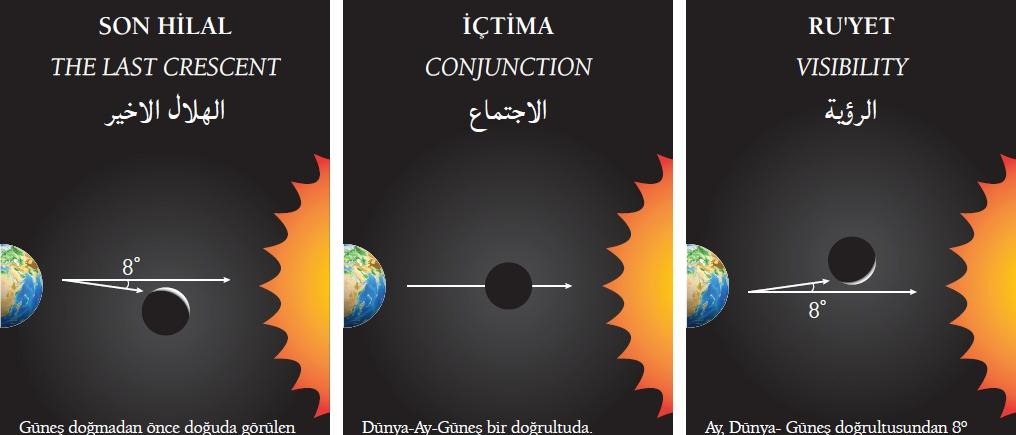
    It is adopted that the first sight of the crescent is possible when the moon's elongation (separation angle ) is 8 degree and the moon's altitude is 5 degree when the sun sets

    There are two criteria to be achieved when sighting a crescent. The criteria are as follows: the altitude of the moon is 5 degrees when the sun sets, and the elongation or seperation angle is 8 degrees. If either criteria are not met, it will not be possible to see the first crescent with the naked eye.

    The conjunction time must be before Fajr time in Australia and New Zealand when a crescent is seen according to Greenwich time.

    Any crescent must also be visible from lands in the American Continent when it appears.

    Read more
Mosque